AGN & Black Hole Binaries
When two galaxies merge, their central supermassive black holes sink toward each other and form a gravitationally bound binary. Detecting these binaries before they merge is one of the open challenges in extragalactic astronomy, because their gravitational wave signal is too low-frequency for current detectors and their electromagnetic signatures are ambiguous.
One candidate that attracted enormous attention is the quasar J1430+2303, which showed periodic optical variability that some interpreted as the signature of two black holes orbiting each other with a shrinking period, a system on the verge of coalescence.
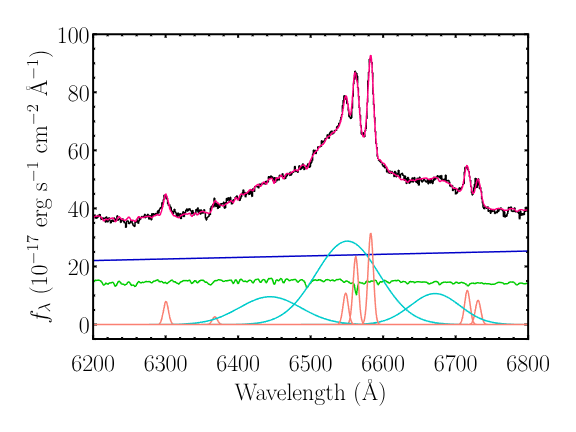
In Tick Tock, I investigated this claim using UV-optical spectra from the Hubble Space Telescope and ground-based facilities. The spectral analysis told a different story. The broad emission line profiles, their variability, and the continuum behavior are more naturally explained by changes in the accretion disk itself - not by a binary. My final analysis proposed an alternative explanation, and the manuscript has been submitted for publication.
In a related project on J0950+5128, I participated in line-profile decomposition and accretion disk modeling to understand why some AGN show deviations from the standard thin-disk picture. The goal is to constrain whether binary-induced perturbations leave detectable imprints on the disk kinematics, or whether the variability has a simpler origin.