Young Stars & Stellar Formation
Stars are born in collapsing clouds of gas and dust, and for a brief window, like a few million years, they're still actively accreting material from their surroundings. These young stellar objects (YSOs) carry telltale spectroscopic signatures: emission lines from infalling gas, and a phenomenon called "veiling," where excess continuum emission from the hot accretion shock washes out the star's photospheric absorption lines.
The problem is that most large spectroscopic surveys weren't designed to find YSOs. They were built for galaxies, quasars, and evolved stars. But YSOs are hiding in the data anyway: you just have to know how to look.
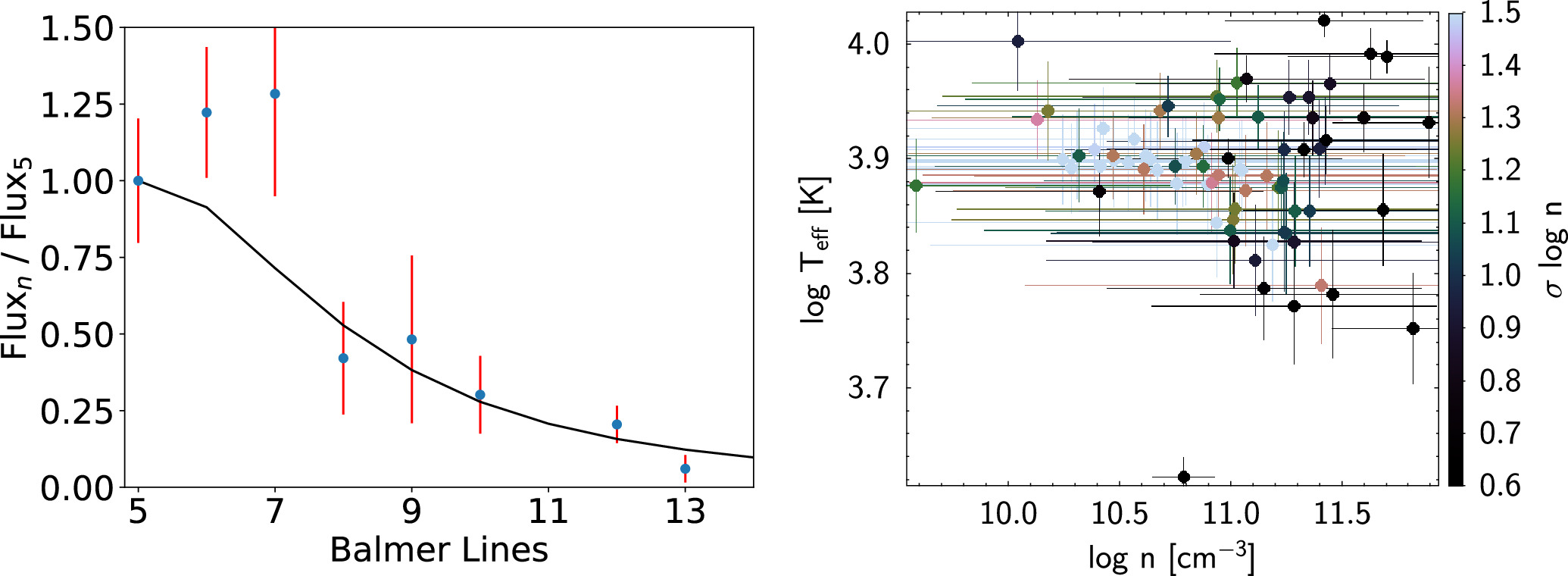
In ABYSS II, I built a full data pipeline to systematically detect and characterize YSOs in SDSS-BOSS spectra. The pipeline identifies accretion signatures, measures veiling, and classifies objects by their evolutionary stage. We found hundreds of YSO candidates, many previously unrecognized.
In a companion project, I developed an empirical calibration for stellar veiling in optical BOSS spectra. Veiling is a direct tracer of the accretion rate, but measuring it reliably in moderate-resolution survey spectra is tricky. The calibration I built validates accretion diagnostics across hundreds of YSOs and provides a tool that others can apply to future SDSS data releases.
Both papers are published in The Astronomical Journal and the analysis code is publicly available. I've also presented this work at multiple conferences.